The History of Simlish: The Secret Language of The Sims and How It Was Born
Following the tremendous success of SimAnt in 1991, renowned game designer Will Wright, inspired by the influential urban design book “A Pattern Language,” embarked on an innovative project – what he described as a “digital dollhouse”. The central concept behind this simulation game was to empower players to construct virtual homes and observe how aspects of architecture and environmental design could profoundly influence the emotional states, behaviors, and overall well-being of digital inhabitants, or sims.
Nevertheless, the initial version of this groundbreaking life simulation game failed to captivate focus groups. The real breakthrough occurred when designer Roxy Wolosenko proposed a pivotal shift to Will Wright: instead of prioritizing architectural elements, the development team should focus on the virtual characters – the sims themselves – including their unique personalities, interpersonal interactions, daily routines, and evolving life stories. This evolutionary change shaped the future direction of The Sims franchise.
This was the beginning of the work on The Sims, one of the most influential simulation games in video game history. One of the critical design questions quickly emerged: which language should the sims speak to ensure the best possible player immersion and universal appeal?
The Birth of a Language: From Failure to Genius
In the late 1990s, while working on The Sims, Will Wright faced a serious problem. If the sims spoke English or any other real language, players would quickly notice repeating phrases, which would shatter the magic of immersion. Moreover, voice acting in multiple languages would cost an astronomical sum, and dialogue localization would become a nightmare for the developers.
Wright experimented with different options: he tried Ukrainian, Navajo, even attempted to mix Swahili and Cherokee. But none of the options worked. Real languages were still recognizable, and their repetition quickly became tiresome.

The situation changed dramatically thanks to two talented voice actors, Stephen Kearin and Gerri Lawlor. Kearin was known for his ability to reproduce an incredible number of vocal sound effects. At his suggestion, they brought in actress Gerri Lawlor as his partner, with whom he had experience doing joint improvisation.
The first few sessions in the studio were a real trial. The actors tried everything: spoke backwards, imitated underwater speech, reproduced ancient dialects, but nothing worked out. The atmosphere was becoming increasingly tense.
Sensing the team's growing frustration, Kearin decided to propose a radically different approach. He recalled an old improv game called "foreign poet": one person speaks complete gibberish with emotions and intonations, while the partner tries to interpret its meaning on the fly.
Stephen Kearin: "We were recording this over existing animations, so Claire said: 'Sure, let's try it, it can't get any worse'".
Kearin and Lawlor began improvising a nonsensical language over simple character animations. And suddenly everything clicked perfectly. The basic meaning of actions was conveyed through icons and visual cues, while the language itself created an emotional backdrop, leaving room for the player's imagination. The team had finally found what they were looking for.
That's how Simlish was born – not a carefully crafted language with grammar and rules, but pure improvisation, where intonation and emotions matter more than the words themselves.
The Philosophy of Language: Imagination Matters More Than Words
In a 2020 interview, Will Wright explained his philosophy behind creating Simlish: "When characters speak gibberish, the human imagination fills in the gaps itself and turns it into a real conversation. That's how we offload part of the simulation onto the player's imagination".
Working in the Studio: Creativity and Madness
At first, Lawlor and Kearin would literally sit in the recording studio for hours and produce incoherent sounds in different tones. They received simple prompts: "Your Sim is hungry," "Your Sim is angry," "Your Sim is flirting." The actors had to react with whatever sounds came to mind. If something fit the emotional tone of the animation, they'd record it and use it in the game.
Gerri Lawlor recalls: "You have to be able to convey very specific things, like pouring three glasses of wine and being happy about it. And then pouring three glasses of wine and not being happy about it at all, but genuinely angry".
The actors would do 30 takes of the same interaction, changing intonations each time to avoid repetition. It was exhausting work, but Lawlor and Kearin tried to have as much fun as they could.
Gerri Lawlor admits: "Specifically for Will Wright, we'd secretly slip in little phrases that weren't in Simlish. For example, a character whose kitchen was on fire would say: 'Oh shit, my kitchen's on fire, Will Wright never picks up his chicken, I hate him... Damn you, Will Wright.'"
From Chaos to Structure: The Emergence of a Dictionary
Although Simlish was conceived as a completely meaningless set of sounds, over time established words and phrases began to appear in it. Kearin and Lawlor deliberately created code words with specific meanings to make their work easier and add depth to the language.
Plok – coined by Stephen Kearin. It means something like "damn it" or "whatever." In truth, the word sounded like a profane English word, which created a comical effect.
Nooboo – baby or child. This word became one of the most recognizable in Simlish.
Wolfem – animal or pet. The word appeared thanks to Lawlor's ex-boyfriend, who called all his pets that.
Gradually, such words became more and more numerous. Despite the fact that Simlish was not originally intended as a full-fledged language, over time it began to grow into something more. The actors unexpectedly found themselves reading actual scripts for a language they had created from improvisation.
The Evolution of Simlish in the Game Series
The Sims (2000–2004)
At first, Simlish was as raw and strange as possible: a real audio mix of all the obscure languages on the planet. Characters would mumble phrases like "wawa bralala?", "ralalalalib bubaya", "commun snanna" and "o frazinnratt".
Interaction possibilities were limited, and sims' emotions were expressed through simple means: thought bubbles and body animation. If sims didn't get along with each other, a bubble with a red X would appear over one's head, highlighting the other's face. When a sim was happy, they simply waved their arms in the air.
The number of recorded phrases was limited, which led to noticeable repetition. But by 2000 standards, this was revolutionary: characters sounded lively and emotional, allowing players to make up their own stories.
The Sims 2 (2004–2009): The Golden Age of Development
The Sims 2 improved a lot compared to the original. Simlish became clearer and more intelligible, pronunciation improved, vowel sounds became more distinct. Indistinct phrases like "e wam" disappeared, replaced by recognizable expressions.
Standard greetings appeared: "Sul sul" (hello) and "Dag dag" (bye). When a character had a problem, they'd shout "Shooflee" or "Anaconda". Characters could flirt, exchanging phrases like "Ooh, voodoo!" and getting "Lick a rock!" in response.
New systems were added to the game – wants and fears, an expanded metric for tracking relationships. Sims could talk to themselves and display strong emotions upon achieving goals or during tragedies.
It was during this period that Simlish began to transform into a recognizable set of phrases that players started to memorize and turn into memes.
The Sims 3 (2009–2014): The Peak of Evolution
The third installment of the series marked the true heyday of Simlish. The language gained maximum expressiveness and recognizability. A mood system was added, which changed a sim's behavior and manner of speech depending on multiple factors – quality of sleep, social interactions, environment.
Simlish transformed into a recognizable set of words and expressions with speech patterns, although grammar as such still didn't exist. Phrases like "Zo hungwah" (very hungry), "Oh Feebee Lay" (I want to eat), "Neeba zow" (I need you now) became part of the gaming lexicon.
Radio stations were filled with new genres – dubstep, techno, electronic. But most importantly, the game featured actual hits by popular artists, re-sung in Simlish. Pressure by Paramore, Last Friday Night by Katy Perry, tracks by Hot Chip and Lily Allen – all of this could be heard on virtual radio.
It was during this period that fans began massively creating unofficial Simlish dictionaries, trying to systematize and decipher the language. Entire communities dedicated to studying Simlish appeared on the internet.
The Sims 4 (2014 – Present): Maximum Complexity
In the latest installment of the series, Simlish reached previously unprecedented complexity and variety. Characters gained the ability to:
Carry on multi-way conversations with several sims at onceCommunicate while performing other actions (for example, while eating)Use different greeting variants depending on personality and mood (friendly, mean, funny)
A conversation tracker appeared at the top of the screen, allowing you to follow who your sim is talking to and in what manner (friendly, flirty, hostile). Each expansion pack extends the sims' "vocabulary" with new phrases and expressions.
Even 25 years later, Simlish continues to evolve while remaining true to its original concept – a language of emotions and imagination.
Simlish in Music: When Stars Sing Gibberish
Starting with The Sims 2, developers began inviting popular musicians to record versions of their hits in this made-up language. The idea was simple and genius at the same time: bring popular music into the world of sims, but adapt it to the fictional language. For each song, a special Simlish text was created that wasn't literally translated, but imitated the rhythm, melody, and emotional mood of the original.
The list of artists who recorded tracks in Simlish is impressive:
- Katy Perry – Last Friday Night
- Paramore – Pressure
- Pixie Lott – Mama Do
- Lily Allen
- Nelly Furtado
- The Pussycat Dolls
And that's just a small fraction – over the years of the series' existence, more than a hundred artists have recorded songs in Simlish. As musicians admitted, singing in Simlish is a strange, liberating, and incredibly fun experience. The language gives you the freedom to be maximally emotional and expressive without being tied to the meaning of words.
The Simlish Alphabet: An Attempt at Systematization
Although Simlish has no official grammar and structure, it has its own alphabet. It's based on symbols that can be seen in the game, for example, on TV screens, billboards, in interfaces.
The Simlish alphabet corresponds to the Latin alphabet as follows:

Enthusiasts have even created a custom Simlish font. This font allows you to write text in Simlish, although it's not official and can't be used to decipher all inscriptions in the game, since there are many variations of spelling.
Interestingly, sometimes this font can be used to decipher texts in the game. For example, on an official screenshot from The Sims 4 featuring a TV show, the Simlish text decodes as "The Tonight Show with Tony Cliffton" – a reference to the famous American talk show.
In The Sims 3, on billboards you can find references to pop culture: for example, a billboard with text referring to "Better Call Saul" from the series "Breaking Bad".
Interesting Facts
Simlish Is Older Than The Sims
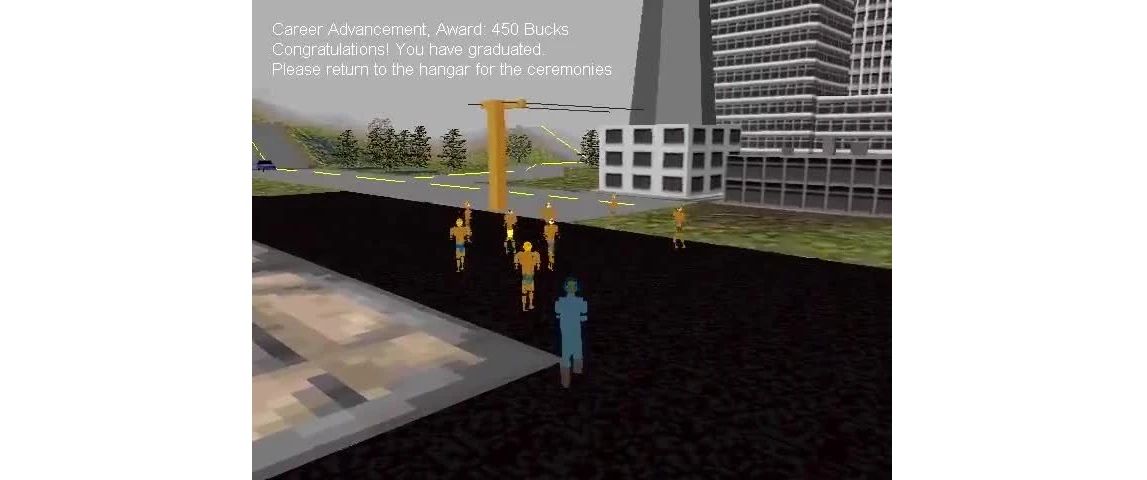
Although Simlish is associated exclusively with The Sims, it first appeared in the low-poly flight simulator SimCopter in 1996. There, the language existed in the form of simple grunts, sighs, and exclamations from pilots. Will Wright decided to develop this idea and carry over the concept of a universal language to his next project.
Universality as a Design Solution
Simlish was created in such a way that no culture would have a linguistic advantage. Claire Curtin, audio director, explained: "We wanted to create one language for the entire game that would work for the whole world."
This wasn't just a technical cost-saving device, it was a political and cultural decision. All players around the world equally understood or didn't understand the characters, interpreted tone, gestures, and context. No one had "native language advantage". This made the game maximally inclusive.
Secret Phrases in English
Despite the fact that Simlish is supposed to be completely fictional, sometimes real words slip through in the games:
- In The Sims, when a child is eating, they might say "Mmm... yummy!"
- When a character is cutting food, you can sometimes hear "Ouch!"
- In The Sims 3, the sports channel announcer says "Look at him go!"
- In The Sims 4, characters can say "Uh-oh," "Duh," "Boom!"
A Cryptographic Message to Fans
On the official website of The Sims 4 before the game's release, a secret message in Simlish was posted. The code was deciphered gradually through hints from different members of the development team. The decoded message read:
"Because you took the time to decode this message, here's why we love you: Your creativity captivates us, your enthusiasm inspires us. May 23, June 18, July 9, remember these days. Without you, we wouldn't have come this far. We're making this game for you, because of you. Thank you for being the greatest fans in the world".
Famous Words and Phrases: A Mini Phrasebook
For those who want to understand their sims a little better, here's a list of the most recognizable words and phrases:
Greetings and Farewells:
- Sul sul — hello/bye
- Dag dag — hello/bye/okay
- Vadish / Litzergam — thank you
Emotions and States:
- Shooflee — help! / distress signal
- Wabadebadoo — I'm on fire!
- Zep tor maboo — help! There's a fire!
- Jadosi — I like this!
- Gronk — unhappy / school
- Dwam — swear word
Needs:
- Zo hungwah — very hungry
- Oh Feebee Lay — I want to eat
- Jigga — to pee / to vomit
- Atohteh — I need to use the bathroom
Social:
- Neeba zow — I need you right now
- O Vwa Vwaf Sna — nice to meet you
- Yib-Sim — best friends
- Kik — kiss
Common Words:
- Nooboo — baby, child
- Woofum / Woven — pet / dog
- Gerbit — llama
- Plok — damn it / whatever
- Ne / Neibs — no
- Ongie — selfie
- Chumcha — pizza or Chinese food
Numbers:
- Mik — 1
- Mak — 2
- Maka — 3
Time:
- Fruby — Friday
- Nart / Nu — night
- Minnai — in the evening
- Wub mezino — for a second
Games:
- Checkmar / Mack-chate — checkmate
- Dobbinips — dominoes
Other:
- Ilana — island
- Clops — clothes
- Mik Up — makeup
- Fretishe — everything
- Vous — you
- Laka — like (in the sense of "as")
This is only a small fraction of known words. Fans continue to add to unofficial dictionaries, finding new patterns and expressions.
The Fate of the Creators: Stars Who Were Forgotten
Gerri Lawlor and Stephen Kearin became true legends among The Sims fans, although the general public didn't know their names for a long time. They created a language that was heard by millions of players around the world, but remained in the shadows themselves.
When The Sims came out in 2000 and became one of the best-selling video games of all time, the creators of Simlish themselves were blown away by the success.
Fame came unexpectedly. Lawlor recalls: "I'd voiced many things for charity and even been featured in some notable projects. But nowhere else was there anything like little girls crying at the sight of me and saying: 'Oh my God, you're the voice from The Sims'. I was like a celebrity. It was so weird for me."
Over time, the voice acting team for the series expanded. Lawlor partially changed her line of work and became a voice director for subsequent installments of The Sims. The actors discovered that they were now reading actual scripts for a language they had once created from pure improvisation.
But the story didn't end as happily as it could have. After some time, Lawlor and Kearin stopped participating in the development of The Sims series. From their interview with TechRadar, it became obvious that this decision was made by the publisher EA, and not of their own accord. The actors clearly weren't pleased with this turn of events, though they avoided direct comments.
Simlish is a brilliant design solution that became a cultural phenomenon. It was born out of desperation, evolved thanks to talent, and became a symbol of an entire gaming universe.
This language proved that you don't need intelligible words for an emotional connection with characters – intonation, gestures, and human imagination are enough. It showed that limitations can become advantages if you approach them creatively.
In a world where artificial intelligence is learning to speak all languages, and translators are becoming more and more sophisticated, Simlish remains a pleasant reminder that not everything needs to be understood literally. Sometimes it's enough to just feel.